

Ag issues considered by TFB Resolutions Committee
(WACO, Texas)—Data centers, transmission lines and nuisance wildlife were among the topics reviewed by the Texas Farm Bureau (TFB) Resolutions Committee Nov. 2-3 in Waco.
The committee, comprised of 41 TFB members representing diverse sectors of Texas agriculture, spent two days reviewing, deliberating and consolidating more than 200 resolutions to both state and national policies submitted by county Farm Bureaus across the state.
“That’s the great thing about Farm Bureau being a grassroots organization. Everything starts at the county level and works its way up to the Resolutions Committee before going to the annual meeting,” said Warren Cude, TFB vice president and chair of the Resolutions Committee. “We have members from across Texas discussing issues that affect farmers and ranchers every day, as well as challenges we may face in the future.”
Data centers and their potential impacts on water resources and private property rights were among the issues discussed.
Committee members supported requiring data centers and other large industrial facilities to disclose projected, direct and indirect water use to counties, groundwater conservation districts and the Texas Water Development Board.
Other water-related resolutions addressed notifying adjacent landowners and groundwater rights owners when historical groundwater use is changed or converted to other purposes. The committee also supported state assistance to provide legal and data resources for managing groundwater and establishing new groundwater conservation districts.
The committee opposed granting data centers special status that could allow them to use eminent domain to acquire private land or easements.
Growing electricity demand and its impact on agricultural land also prompted discussion about new transmission lines.
Committee members opposed new high-capacity transmission line projects of 345 kilovolts or greater unless the need for additional power is clearly demonstrated, affected landowners and stakeholders have opportunities to provide input, and alternatives such as regional power generation and storage are fully considered.
The committee supported incentives for solar companies to incorporate agrivoltaic practices that combine agricultural production with solar energy generation.
Other resolutions addressed proper management and remediation of oil and gas reserve pits, voluntary efforts to reduce light pollution and public notification and consent for weather modification activities.
Committee members supported encouraging the Texas Parks and Wildlife Department to improve methods for estimating deer populations and establishing appropriate population levels to help reduce agricultural damage caused by overpopulated deer herds.
“These discussions show just how many different issues affect agriculture across Texas,” Cude said. “Whether it's protecting private property rights, managing natural resources, improving federal agriculture programs or addressing damage to crops and livestock, our members want policies that help farmers and ranchers continue doing what they do.”
National policy recommendations included changes to diesel exhaust fluid system requirements, providing a non-electronic identification option for all livestock species and additional federal research on pasture mealybug.
The committee also supported removing federal protections for black vultures and researching additional control methods to reduce damage to livestock.
“Not every county faces the same challenges, but this process gives each Farm Bureau district a voice in developing our policies,” Cude said. “Our job is to bring those ideas together and give our voting delegates recommendations that reflect the needs of Texas agriculture.”
The policy recommendations will be considered by TFB voting delegates during the business session of the organization’s 93rd Annual Meeting Dec. 4-6 in Waco.
State resolutions adopted at the TFB annual meeting become policies that guide the organization. National resolutions, if adopted by voting delegates at the TFB annual meeting, are sent to the American Farm Bureau Federation (AFBF) Resolutions Committee for consideration.
Resolutions supported by the AFBF Resolutions Committee and approved by AFBF voting delegates in January provide a roadmap for the national organization.
For a tentative agenda and more details on TFB’s annual meeting, visit texasfarmbureau.org/annualmeeting.
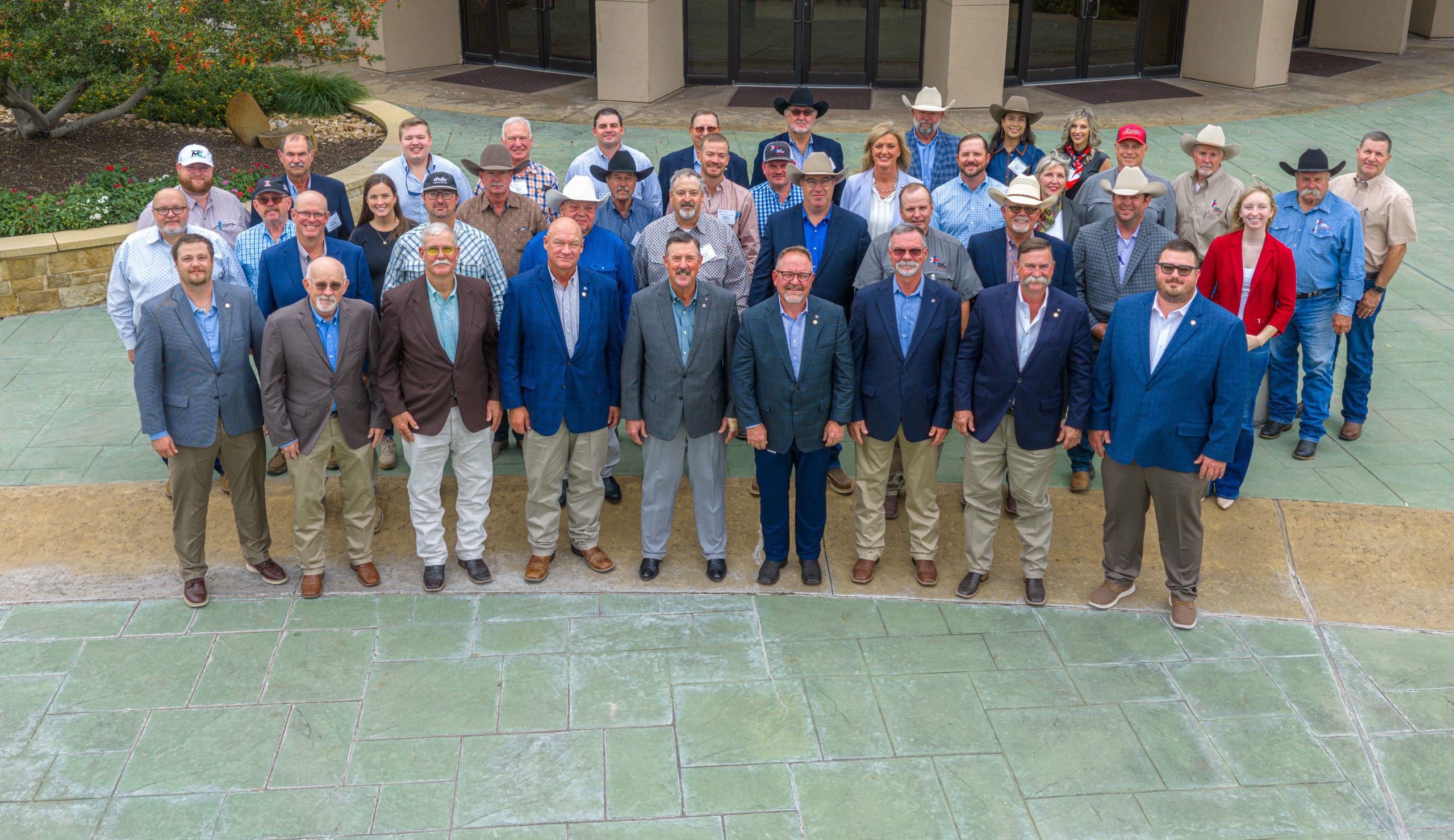
The 2026 Texas Farm Bureau Resolutions Committee met Nov. 2-3 in Waco to review proposed policy resolutions from county Farm Bureaus (CFB) across the state.
Row 1 (left to right): Mark True, TFB District 2 state director; Michael Moon, TFB District 8 state director; Brian Adamek, TFB secretary-treasurer; Russell Boening, TFB president; Warren Cude, TFB vice president and Resolutions Committee chair; Steve Bauer, TFB District 10 state director; James Foster, TFB District 4 state director; and Zachary Mengers, YF&R Advisory Committee vice chair.
Row 2 (left to right): Zack Altman (Hall-Donley CFB), Jeffrey Carlson (Deaf Smith CFB), Cade Wyatt (Childress CFB), Kem Bales (Bailey CFB), Bobby Byrd (Hale CFB), Jaret Reaves (Cooke CFB), David Harmonson (Jack CFB), Mark Daniel (Baylor CFB), Bart Weston (Collin CFB) and Kaitlin Lavendar (Tarrant CFB).
Row 3 (left to right): Brian Triplett (Bowie CFB), Matt Garrett (Harrison CFB), Heather Lundgren (Red River CFB), Wayne Tinkler (Pecos-Reeves CFB), Mark Morrow (Nolan CFB), Stetson Rasberry (Fisher CFB), Travis Eberhart (Erath CFB), Jessica Richmond (Comanche CFB), Kevin Corzine (Jones CFB), Anna Kantor (Limestone CFB), Gerald Yezak (Robertson CFB), John Griffith (Cherokee CFB), Larry Joiner (Angelina CFB) and Clay Jones (Nacogdoches CFB).
Row 4 (left to right): Taryn Titsworth (Medina CFB), Michael McMahon (Gillespie CFB), Brock Sanford (Brazoria-Galveston CFB), Hilary Gleitz (Waller CFB), Clint Wiggins (Brazos CFB), Ivan Jaskinia (Karnes CFB), Milton Lowak (Wilson CFB), Terry Wayne “Buck” Ryhner (Cameron CFB), Alyssa Hind (Hidalgo CFB), and Kelsey Shea Chopelas (San Patricio CFB).